
The moment I stepped out of Queen Alia International Airport into the dry Amman heat, a taxi driver named Hassan pressed a tiny cup of sage tea into my hands and said, “Welcome to Jordan — we have been expecting you.” That single gesture set the tone for seven days that would take me from Roman ruins perched above a sprawling capital, through the rose-red canyon walls of Petra, across the rust-colored silence of Wadi Rum, and down to the strange, salt-crusted shores of the Dead Sea. Jordan is a country that punches absurdly above its weight: smaller than Indiana, yet home to one of the New Seven Wonders, the lowest point on Earth, and a food culture that will ruin hummus for you forever. I have traveled through Jordan three times over the past four years, most recently in spring 2026, and this guide distills every lesson, every budget hack, and every breathtaking sunset into a single seven-day route that works whether you are backpacking on 40 JOD (about 56 USD) a day or treating yourself to a desert glamping tent under a million stars.
1. AMMAN’S CITADEL AND THE ROMAN THEATER
Amman is the kind of city that reveals itself slowly. On the surface it looks like a jumble of white limestone apartment blocks cascading down impossibly steep hills, but spend a morning on Jabal al-Qal’a (Citadel Hill) and you start to understand why civilizations kept building here, one on top of the other, for seven millennia. The entry ticket costs just 3 JOD (4.23 USD) and includes the Jordan Archaeological Museum, a small but riveting collection that houses some of the Dead Sea Scrolls fragments and the haunting Ain Ghazal statues — plaster figures with inlaid shell eyes that date to 7000 BCE. I arrived at 7:30 in the morning, before the tour buses, and had the Temple of Hercules columns almost entirely to myself. The light at that hour is extraordinary: low and golden, casting long shadows across the Umayyad Palace ruins while the call to prayer echoes up from the valley below.
From the Citadel, a fifteen-minute walk downhill through narrow residential streets brings you to the Roman Theater, a 6,000-seat amphitheater carved into the hillside around 138 CE during the reign of Antoninus Pius. Admission is 1 JOD (1.41 USD), and the acoustics are still startlingly good — I watched a local musician test them with an oud, each plucked note reaching the top row with crystalline clarity. Flanking the theater are two small museums: the Jordan Museum of Popular Traditions and the Folklore Museum, both included in the ticket price and worth a quick loop for their Bedouin jewelry and traditional dress displays.
After the theater, I crossed Hashemite Plaza and dove into downtown Amman’s souk district along King Talal Street. The energy here is infectious: spice vendors stacking pyramids of turmeric and sumac, juice sellers pressing pomegranate and orange, tailors stitching in narrow doorways. I stopped at Habibah Sweets on Al-Malek Faisal Street for a plate of fresh knafeh — the famous Nabulsi cheese pastry soaked in orange-blossom syrup — which cost 0.75 JOD (1.06 USD) and arrived so hot I burned the roof of my mouth. Worth every blister.
In the evening, I took a taxi (about 2.50 JOD / 3.53 USD from downtown) up to Rainbow Street in Jabal Amman for its cafe scene and sunset views. Books@Cafe, a bookshop-bar hybrid on the terrace overlooking the city, serves local Carakale craft beer for 5 JOD (7.05 USD) a pint and has the kind of progressive, literary atmosphere you might not expect in the Middle East. It was here, watching the Citadel light up across the valley, that I realized Amman is not just a gateway city — it is a destination in its own right.
Planning tip: Buy the Jordan Pass online before your trip. At 70 JOD (98.70 USD) for the basic “Jordan Wanderer” tier, it covers your visa fee (normally 40 JOD), entry to Petra, and admission to over 40 sites including the Citadel and Roman Theater. It pays for itself on day one if you are visiting Petra.
2. JERASH: A DAY TRIP TO THE POMPEII OF THE EAST
If the Roman Theater in Amman whetted your appetite for antiquity, Jerash will leave you speechless. Located just 48 kilometers north of the capital, this sprawling Greco-Roman city is often called the “Pompeii of the East,” and the comparison is not hyperbole. Unlike Pompeii, however, Jerash was never buried under ash — it was simply abandoned and slowly swallowed by earth, which means the columns, temples, and colonnaded streets have survived with an almost eerie completeness. I caught a public minibus from Amman’s Tabarbour Bus Station for 1 JOD (1.41 USD) each way. The ride takes about an hour, drops you 200 meters from the entrance, and the return buses run until early evening.
Entry to Jerash costs 10 JOD (14.10 USD), but it is covered by the Jordan Pass. I spent four hours wandering the site and could have easily spent more. The Hadrian’s Arch entrance gate sets the scale immediately — a triple-arched monument built in 129 CE to honor Emperor Hadrian’s visit. From there, a processional road leads to the iconic Oval Plaza, ringed by 56 Ionic columns that still cast their shadows across the original limestone paving. I hired a local guide named Mahmoud at the entrance for 20 JOD (28.20 USD) for a two-hour tour, and it was the best money I spent all week. He pointed out details I would have walked right past: grooves worn into the stone by ancient chariot wheels, a sophisticated underground drainage system, and the way the Temple of Artemis columns flex visibly in the wind if you wedge a spoon into the gap at their base (a trick the guards demonstrate for tips).
The South Theater is another highlight, a 3,000-seat venue where a troupe of retired Jordanian military musicians called the Jerash Heritage Band performs daily. They play bagpipes and drums in Roman legionnaire costumes, and while it sounds kitschy, the acoustics of the theater turn the performance into something genuinely stirring. Tips are appreciated — I left 2 JOD (2.82 USD). Beyond the theater, the Cardo Maximus stretches nearly 800 meters north, its columns marching toward the North Theater and the ruins of several Byzantine churches with remarkably intact mosaic floors.
For lunch, I walked back to the modern town and ate at Lebanese House Restaurant near the entrance, where a massive mixed grill platter with salads, hummus, bread, and tea came to 8 JOD (11.28 USD). The portions were absurd and the owner refused to let me leave without a complimentary dessert. Jordanian hospitality is relentless in the best possible way.
Planning tip: Visit Jerash on a weekday morning to avoid school groups. Bring a hat, sunscreen, and at least a liter of water — there is almost no shade on site, and summer temperatures regularly hit 38 degrees Celsius. The minibus back to Amman can be flagged down on the main road outside the site entrance; just ask any shopkeeper to point you to the right spot.
3. A DEEP DIVE INTO JORDANIAN FOOD
Let me be direct: Jordanian food does not get the attention it deserves. While Lebanese and Israeli cuisines dominate the international conversation about Levantine cooking, Jordan quietly serves some of the most soulful, generous, and intensely flavored meals in the region. The cornerstone is mansaf, the undisputed national dish — slow-cooked lamb nestled on a bed of fragrant rice and drenched in jameed, a tangy sauce made from dried fermented yogurt reconstituted with broth. It is traditionally served on an enormous communal platter and eaten with the right hand, the rice and meat rolled into balls with the fingers. I had my best mansaf at Tawaheen al-Hawa in Amman, a restaurant set in a converted Ottoman mill on the Citadel hillside. A full mansaf for two with sides cost 18 JOD (25.38 USD), and the lamb was so tender it fell apart at the suggestion of a fork.
Street food in Jordan is equally compelling. In downtown Amman, Hashem Restaurant has been serving what many consider the country’s best falafel since 1952. The place is an institution: open-air, no menu, just plate after plate of crispy falafel, creamy hummus, ful medames (stewed fava beans), and fresh-baked bread arriving at your table almost before you sit down. A full meal here costs around 3 JOD (4.23 USD) per person, and the restaurant operates 24 hours a day, seven days a week. I went twice — once for a late lunch and once at midnight, when the crowd was a fascinating mix of taxi drivers, university students, and wide-eyed tourists who had stumbled in from Rainbow Street.
No discussion of Jordanian food is complete without knafeh, that glorious collision of shredded phyllo pastry, stretchy Nabulsi cheese, and rosewater-scented syrup. Habibah Sweets downtown is the most famous purveyor, but I also loved the version at Al-Quds Sweets near the Husseini Mosque, which uses a slightly thicker cheese layer and a more aggressive hit of orange blossom. A generous serving at either place runs 0.75 to 1 JOD (1.06 to 1.41 USD). Other dishes to seek out include maqluba (an upside-down rice and vegetable cake), musakhan (roasted chicken on taboon bread with sumac and onions), and zarb — a Bedouin barbecue cooked underground in the desert, which I would encounter later in Wadi Rum.
For a more upscale experience, Sufra Restaurant on Rainbow Street occupies a beautiful 1920s villa with a garden terrace. Their mezze spread — including muhammara, labneh with za’atar oil, and vine leaves stuffed with lamb — is outstanding, and a full dinner with drinks comes to about 25 JOD (35.25 USD) per person. The wine list features bottles from Saint George Winery and Jordan River Wines, and yes, Jordan has a small but genuine wine tradition. A bottle of local red runs about 15 JOD (21.15 USD) at restaurant prices.
Planning tip: If you want to learn to cook Jordanian food, book a class with Beit Sitti in Amman. Run by three sisters in their grandmother’s house in Jabal Weibdeh, the hands-on session costs 35 JOD (49.35 USD) per person and includes preparing and eating a full meal. Book at least a week in advance — sessions fill up quickly, especially in spring and autumn.
4. FLOATING IN THE DEAD SEA
The drive from Amman to the Dead Sea takes about an hour, dropping from 900 meters above sea level to 430 meters below it in a series of switchbacks that make your ears pop. I rented a car for the day through Avis Jordan at their downtown Amman office for 30 JOD (42.30 USD) including basic insurance, which gave me the flexibility to stop at viewpoints along the way — including Mount Nebo, the peak where Moses is said to have glimpsed the Promised Land before his death. Entry to Mount Nebo is 2 JOD (2.82 USD), and on a clear day you can see the Jordan Valley, the Dead Sea, and the faint outline of Jerusalem across the haze.
For the Dead Sea itself, you have two main options on the Jordanian side: the public Amman Beach (15 JOD / 21.15 USD entry, includes locker and shower) or the private beach clubs attached to the resort hotels. I chose Kempinski Hotel Ishtar Dead Sea, which offers day passes for 35 JOD (49.35 USD) including pool access, towels, and a credit toward food and drink. The facilities are immaculate, the infinity pool appears to merge with the Dead Sea itself, and the staff hand out free mud from designated troughs so you can slather yourself head to toe in mineral-rich black goop — the quintessential Dead Sea selfie.
Floating in the Dead Sea is an experience that defies description but I will try: imagine lying back in water so dense it actively pushes you upward, like an invisible pool float. Your legs bob to the surface. Your arms float out to the sides. You cannot sink if you try. The water is warm, almost oily, and so saturated with salt and minerals that even a tiny splash in your eyes will send you scrambling for the freshwater showers. I made that mistake exactly once. The sting is extraordinary — like someone rubbed chili paste under your eyelids. Do not shave anything for at least 24 hours before swimming. I cannot stress this enough.
I spent two hours floating, mudding, and rinsing before driving 15 minutes south to Wadi Mujib, a dramatic slot canyon that plunges into the Dead Sea from the Jordanian highlands. The Siq Trail at the Mujib Biosphere Reserve (18 JOD / 25.38 USD, advance booking required) involves wading and swimming through chest-deep canyon water, scrambling over boulders, and finishing with a waterfall shower. It is exhilarating, mildly terrifying, and only open from April through October due to flash flood risk. Waterproof phone pouches are available at the entrance for 3 JOD (4.23 USD), and I strongly recommend getting one.
Planning tip: The Dead Sea is shrinking at an alarming rate — roughly one meter per year — and sinkholes have swallowed sections of the shoreline. Stick to designated swimming areas and never walk along the unguarded southern coast. Also bring flip-flops for the water: the salt crystals on the lake bed are razor sharp and will cut bare feet.
5. PETRA: THE TREASURY AND THE MONASTERY
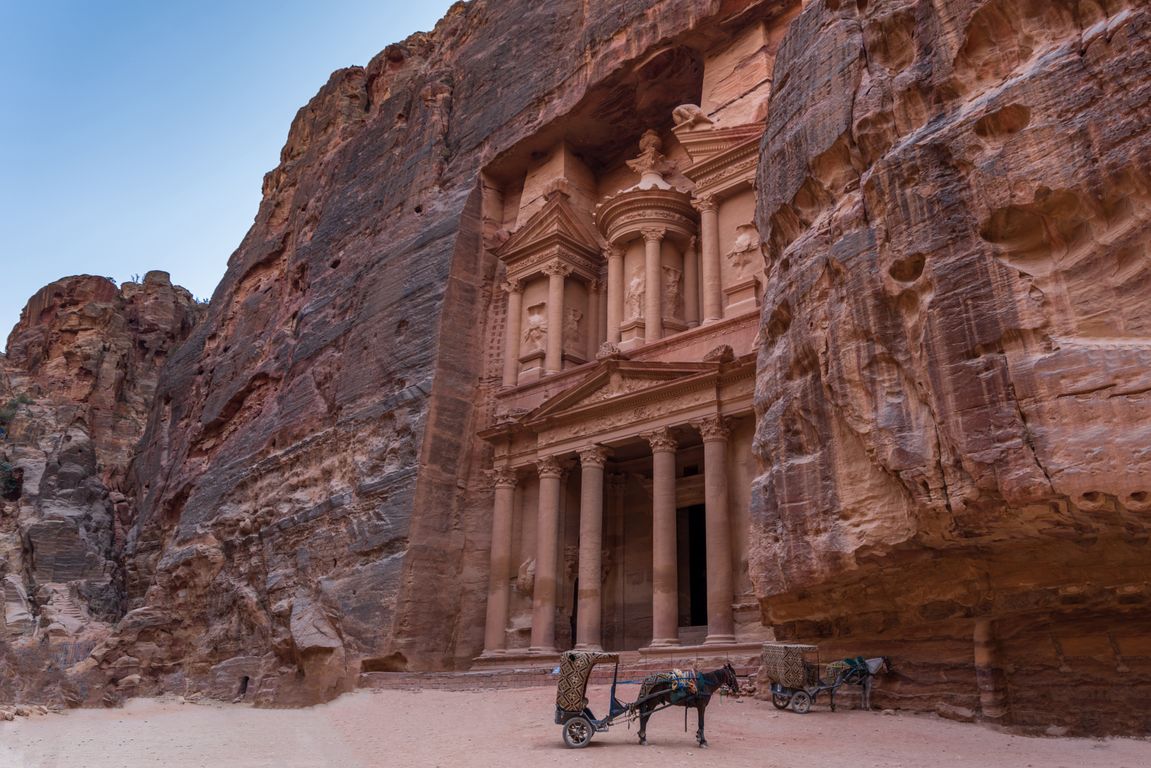
I have seen Petra three times now, and each time the moment the Siq narrows to a final sliver and the Treasury (Al-Khazneh) appears in a blaze of rose-pink sandstone, I feel the same involuntary catch in my chest. It is, without exaggeration, one of the most dramatic reveals in world travel. The 1.2-kilometer walk through the Siq — a narrow gorge with walls soaring 80 meters above your head, carved smooth by ancient water channels still visible in the rock — is a masterclass in architectural anticipation. The Nabataeans knew exactly what they were doing when they designed this entrance two thousand years ago.
Petra entry is steep: 50 JOD (70.50 USD) for a one-day ticket, 55 JOD (77.55 USD) for two days, or 60 JOD (84.60 USD) for three. The Jordan Pass includes one day; upgrading to the “Jordan Explorer” pass at 75 JOD (105.75 USD) gets you two days, and I strongly recommend it. Petra is vast — covering 264 square kilometers — and trying to see it in one day means either a punishing forced march or painful sacrifices. With two days, you can take your time through the Siq and Treasury on day one, then tackle the Monastery (Ad-Deir) and the lesser-visited trails on day two.
The Treasury gets all the Instagram glory, but the Monastery is, to my eyes, the more impressive monument. Reaching it requires climbing 850 hand-cut steps up a winding mountain path — about 45 minutes at a moderate pace — but the payoff is immense. The Monastery’s facade is 47 meters wide and 48 meters tall, significantly larger than the Treasury, and because fewer visitors make the climb, you can often sit on the rocks across the valley and contemplate it in relative solitude. I bought a glass of sweet tea from the Bedouin stall at the top for 2 JOD (2.82 USD) and sat there for 30 minutes, watching the light shift across the carved columns.
Between the Treasury and the Monastery, the main trail passes through the Street of Facades, the Royal Tombs (climb up to the Urn Tomb for sweeping views), the colonnaded Roman-era Cardo, and the Great Temple. Each deserves at least a brief stop. I also recommend the short detour to the High Place of Sacrifice, a mountaintop altar reached via a well-marked trail from the main valley. The climb takes about 25 minutes and rewards you with 360-degree views of Petra’s hidden valleys and the distant Sharah Mountains.
Planning tip: Enter Petra at 6:00 AM when the gates open. By 9:00 AM, the first wave of tour buses from Amman arrives and the Siq becomes a traffic jam of horse carriages and guided groups. Staying in the town of Wadi Musa right at the gate makes early entry easy. I stayed at Rocky Mountain Hotel, a family-run spot with clean rooms, a rooftop terrace with Petra valley views, and breakfast included for 35 JOD (49.35 USD) per double room. For a splurge, Movenpick Resort Petra sits literally steps from the entrance and charges from 120 JOD (169.20 USD) per night.
6. PETRA BY NIGHT AND THE HIDDEN TRAILS
Petra by Night runs every Monday, Wednesday, and Thursday evening, and despite mixed reviews online, I think it is worth doing at least once. The experience costs 17 JOD (23.97 USD) and begins at 8:30 PM at the visitor center. You walk through the Siq in near-total darkness, guided only by hundreds of luminaria — candles set in brown paper bags — lining the path. When you emerge into the Treasury plaza, the entire forecourt is carpeted with 1,500 flickering candles, and a Bedouin musician plays the rababa (a single-stringed fiddle) while a guide shares Nabataean legends. Is it touristy? Absolutely. Did I still get goosebumps when the Treasury materialized out of the candlelit darkness? Also absolutely.
The honest warning: the event is crowded, the walk through the dark Siq is slow, and the “show” at the Treasury is essentially sitting on the ground for 30 minutes listening to stories and music. If you expect a spectacular light-and-sound production, you will be disappointed. But if you approach it as a contemplative experience — a chance to see Petra in a way the ancient Nabataeans might have — it delivers something that daytime visits cannot replicate. Skip the tripod; photography is difficult in the low light and you will spend the whole time fussing with settings instead of absorbing the atmosphere.
On your second day at Petra, ditch the main trail and explore the paths that 90 percent of visitors miss. The Al-Khubtha Trail starts near the Royal Tombs and climbs to a viewpoint directly above the Treasury, offering a bird’s-eye perspective that is staggering. The trail is well-marked but steep, with some exposed sections — not recommended if you have a serious fear of heights, but manageable for anyone with basic fitness and sturdy shoes. At the top, a Bedouin family runs a tea stall and sells handmade jewelry; I bought a silver ring for 5 JOD (7.05 USD) and the seller threw in a cup of tea and a lengthy explanation of his family’s centuries-long connection to Petra.
Another hidden gem is the Wadi Farasa trail, which descends from the High Place of Sacrifice through a series of elaborate tomb facades, the Garden Triclinium, and the Soldier’s Tomb. This route sees a fraction of the foot traffic and offers some of the most intensely colored sandstone in the entire site — bands of crimson, amber, violet, and cream swirling through the rock like geological abstract art. I spent an entire afternoon on this trail and encountered perhaps a dozen other hikers.
Planning tip: Hire a local Bedouin guide for the back trails. Official guides at the visitor center charge 50 JOD (70.50 USD) for a half-day, but informal guides near the Royal Tombs will often lead you on lesser-known routes for 20 to 30 JOD (28.20 to 42.30 USD) and share family stories and local knowledge that no guidebook contains. Always agree on a price before setting out.
7. WADI RUM: DESERT CAMPING AND JEEP TOURS
Wadi Rum is the landscape your subconscious borrows when it builds dreams about Mars. Massive sandstone jebels (mountains) rise vertically from a desert floor of fine red-orange sand, their flanks carved into arches, bridges, and mushroom-shaped hoodoos by millions of years of wind. Lawrence of Arabia called it “vast, echoing, and godlike.” Hollywood agreed, filming “The Martian,” “Dune,” “Star Wars: The Rise of Skywalker,” and “Lawrence of Arabia” itself here. But no screen — not IMAX, not 8K — captures the scale. You have to stand at the base of Jebel Um Ishrin, crane your neck, and feel your own smallness.
I booked a one-night package with Wadi Rum Nomads, a Bedouin-run camp, for 55 JOD (77.55 USD) per person, which included a 4×4 jeep tour, dinner, breakfast, and a private tent with a real bed. The jeep tour lasted about four hours and hit the major sites: Lawrence’s Spring (a natural spring named after T.E. Lawrence), the Khazali Canyon with its Thamudic and Nabataean inscriptions, the Um Fruth Rock Bridge (which you can scramble up for photos), and several lookout points where we stopped to brew tea over a fire. Our driver, Salem, grew up in the desert and navigated the trackless sand with the casual confidence of a London cabbie on the Strand.
Dinner was zarb, the legendary Bedouin underground barbecue. In the afternoon, the camp crew buried a metal drum loaded with chicken, lamb, potatoes, onions, and rice beneath the sand, covered it with coals, and left it to slow-cook for three hours. When they unearthed it at sunset, prying off the lid to release a cloud of fragrant steam, the meat was impossibly tender and infused with smoky, earthy depth. We ate cross-legged on cushions in an open-sided tent, under a sky so thick with stars it looked fake. I counted three shooting stars before I stopped counting. The silence of Wadi Rum at night is profound — not the absence of sound, but a presence, a tangible weight of quiet that settles over you like a blanket.
For those wanting more luxury, Memories Aicha Luxury Camp offers geodesic dome tents with transparent panels for stargazing, private bathrooms, and king-size beds from 130 JOD (183.30 USD) per person. At the other end, Bedouin Directions Camp provides basic but clean communal tents for as little as 25 JOD (35.25 USD) per person including meals and a jeep tour. Whatever your budget, do not skip Wadi Rum — it is the emotional crescendo of any Jordan trip.
Planning tip: The village of Wadi Rum (also called Rum Village) is the gateway, reachable by minibus from Aqaba (7 JOD / 9.87 USD, about one hour) or by taxi from Petra (around 50 JOD / 70.50 USD, negotiable). Most camps arrange pickup from the village visitor center, where you will also need to pay the 5 JOD (7.05 USD) park entry fee (covered by the Jordan Pass). Book your camp at least a few days in advance during peak season (March through May and September through November).
8. GETTING AROUND JORDAN: THE COMPLETE TRANSPORT GUIDE

Jordan’s transport network is functional but requires some planning. The most tourist-friendly option is the JETT bus service, which operates air-conditioned coaches on key routes. The Amman-to-Petra JETT bus departs daily at 6:30 AM from the JETT office near 7th Circle in Amman, costs 12 JOD (16.92 USD) one-way, and takes about three and a half hours via the Desert Highway. Book online or at the office the day before — seats sell out in peak season. JETT also runs a daily bus from Amman to Aqaba (9 JOD / 12.69 USD, four hours) and a service to the Dead Sea (4 JOD / 5.64 USD, one hour), though the Dead Sea route runs less frequently.
Public minibuses are cheaper and cover more routes but operate on a fill-up-and-go basis, meaning they do not leave until every seat is taken. This can mean waits of 30 minutes or two hours, and routes generally stop running by mid-afternoon. Key minibus routes include Amman to Jerash (1 JOD / 1.41 USD from Tabarbour), Amman to Madaba (1 JOD / 1.41 USD from Muhajireen station), and Petra to Wadi Rum (negotiable, usually around 10 JOD / 14.10 USD, though you may need to change in Ma’an). Always confirm the price before boarding, and have small bills ready — drivers rarely make change.
Rental cars offer the most flexibility and are surprisingly affordable. I rented a Kia Picanto through Avis for 25 to 30 JOD (35.25 to 42.30 USD) per day with basic insurance. Gasoline costs around 0.80 JOD (1.13 USD) per liter, and the major highways (Desert Highway, King’s Highway, Dead Sea Highway) are well-maintained and signposted in Arabic and English. A few warnings: Jordanian drivers can be aggressive, particularly around Amman. Lane markings are treated as suggestions. Speed cameras are everywhere and fines are steep — 30 JOD (42.30 USD) minimum. If you are not comfortable with assertive Middle Eastern driving, skip the rental and use JETT for the long hauls, then taxis locally.
Taxis within cities are cheap — a cross-Amman ride rarely exceeds 4 JOD (5.64 USD) — but always insist the meter is running or agree on a price beforehand. Ride-hailing apps Uber and Careem both operate in Amman and are generally cheaper than street taxis. For inter-city transfers, many hotels can arrange private drivers. A private car from Amman to Petra typically costs 70 to 90 JOD (98.70 to 126.90 USD) one way and can be shared among up to four passengers, making it competitive with JETT for small groups.
Planning tip: If you are renting a car and driving from Amman to Petra, take the King’s Highway in at least one direction. It is slower than the Desert Highway (about five hours versus three and a half) but infinitely more scenic, passing through Dana Nature Reserve, the Crusader castle of Kerak, and the mosaic city of Madaba. The road is winding and narrow in places but manageable for confident drivers.
9. JORDAN ON A BUDGET: THREE-TIER COST BREAKDOWN
Jordan is not the cheapest country in the Middle East, but it is not ruinously expensive either. The biggest single cost is Petra admission, which the Jordan Pass significantly offsets. Below is a realistic daily budget breakdown for three spending tiers, based on my most recent trip in spring 2026. All prices are per person, per day, assuming double occupancy for accommodation.
| Category | Budget (JOD / USD) | Mid-Range (JOD / USD) | Splurge (JOD / USD) |
|---|---|---|---|
| Accommodation | 10 / 14.10 (hostels, basic hotels) | 30 / 42.30 (3-star hotels, guesthouses) | 85 / 119.85 (boutique and resort hotels) |
| Food | 8 / 11.28 (street food, local restaurants) | 18 / 25.38 (mix of local and sit-down meals) | 40 / 56.40 (upscale dining, wine) |
| Transport | 5 / 7.05 (public minibuses, shared taxis) | 12 / 16.92 (JETT buses, occasional taxis) | 25 / 35.25 (rental car or private drivers) |
| Activities | 5 / 7.05 (Jordan Pass sites only) | 15 / 21.15 (guided tours, Wadi Rum jeep) | 35 / 49.35 (guides, adventure sports, night events) |
| Miscellaneous | 4 / 5.64 (water, SIM card, tips) | 7 / 9.87 (souvenirs, tips, extras) | 15 / 21.15 (spa, premium souvenirs, tips) |
| Daily Total | 32 / 45.12 | 82 / 115.62 | 200 / 282.00 |
| 7-Day Total | 224 / 315.84 | 574 / 809.34 | 1,400 / 1,974.00 |
The budget tier assumes you are staying in dorm beds or the cheapest private rooms, eating almost exclusively at local street stalls, and relying on public transport. It is absolutely doable — I met several solo backpackers managing on 30 JOD (42.30 USD) per day — but requires discipline and a willingness to forgo some comforts. The mid-range tier is the sweet spot for most travelers: comfortable hotels, a mix of local eats and sit-down restaurants, and enough margin for experiences like Petra by Night and a Wadi Rum jeep tour. The splurge tier assumes boutique hotels like The House Boutique Suites in Amman (from 80 JOD / 112.80 USD), resort stays at the Dead Sea, and luxury desert camps in Wadi Rum.
One cost that catches travelers off-guard is the departure tax of 10 JOD (14.10 USD) at land borders, though this is typically included in your airline ticket if flying. Also budget for tips: rounding up at restaurants is standard, and 1 to 2 JOD for drivers and guides at archaeological sites is expected and appreciated.
Planning tip: The single best money-saving move in Jordan is buying the Jordan Pass before arrival. At 70 JOD (98.70 USD) for the Wanderer tier, it covers your 40 JOD visa and includes one-day Petra entry (50 JOD value), meaning you effectively save 20 JOD before you even visit a second site. Pay for the pass online with a credit card and save the QR code to your phone — you will need to show it at each attraction.
10. CULTURAL ETIQUETTE AND SAFETY IN JORDAN
Jordan is one of the safest countries in the Middle East, and I say that not as a platitude but as someone who has walked through downtown Amman at 2 AM, hitchhiked to Jerash, and camped with strangers in Wadi Rum without a single moment of feeling threatened. Violent crime against tourists is extremely rare. Petty theft is uncommon compared to European tourist capitals. The Jordanian police and tourist police are generally helpful and often speak English. That said, common sense applies: do not flash expensive electronics in crowded souks, keep a photocopy of your passport separate from the original, and be aware of your surroundings in any busy urban area.
Cultural etiquette matters here and a few basics go a long way. Dress modestly, especially outside Amman’s trendy western neighborhoods. For women, this means covering shoulders and knees at minimum; a lightweight scarf for entering mosques is essential. For men, long trousers are preferred over shorts in non-tourist settings. Jordanians are extraordinarily hospitable — you will be invited for tea, coffee, and meals by strangers with startling regularity. Accepting is not just polite, it is one of the great joys of traveling here. When offered Arabic coffee from a traditional dallah, take at least one cup. Declining can be seen as rude. When you have had enough, gently shake the cup side to side as you hand it back.
Ramadan significantly affects daily life and travel logistics. During the holy month, most restaurants close during daylight hours, and eating, drinking, or smoking in public before sunset is considered deeply disrespectful. Hotel restaurants usually remain open for non-Muslim guests, and some tourist-oriented cafes operate discreetly. If your trip falls during Ramadan, embrace it: the iftar (sunset meal breaking the fast) celebrations are magnificent, and many restaurants offer special iftar buffets for 12 to 20 JOD (16.92 to 28.20 USD) that are some of the best meals you will eat in the country.
A few other practical notes: alcohol is legal and available in licensed restaurants, hotels, and liquor stores, but drinking in public or appearing visibly intoxicated is frowned upon. Photography is welcome at all tourist sites but always ask before photographing people, especially women. Bargaining is expected in souks and with taxi drivers but not in fixed-price shops or restaurants. Start at about 40 percent of the asking price and work toward a midpoint — the process should be good-natured, not aggressive. If a vendor seems offended, you have pushed too hard.
Planning tip: Learn a few Arabic phrases. “As-salamu alaykum” (peace be upon you) as a greeting, “shukran” (thank you), and “inshallah” (God willing, used constantly) will earn you smiles everywhere. Jordanians genuinely appreciate the effort, even if your pronunciation is terrible. Also download the Maps.me app with offline Jordan maps before your trip — cell data can be spotty outside cities, and Google Maps occasionally misroutes in rural areas.
YOUR 7-DAY JORDAN ROUTE AT A GLANCE
| Day | Destination | Highlights | Overnight |
|---|---|---|---|
| Day 1 | Amman | Citadel, Roman Theater, downtown souk, Rainbow Street | Amman |
| Day 2 | Jerash (day trip) | Oval Plaza, Temple of Artemis, South Theater, Cardo Maximus | Amman |
| Day 3 | Dead Sea | Mount Nebo, Dead Sea floating, mud baths, Wadi Mujib canyon | Dead Sea or drive to Petra |
| Day 4 | Petra | The Siq, Treasury, Street of Facades, Royal Tombs, High Place of Sacrifice | Wadi Musa |
| Day 5 | Petra | Monastery climb, Al-Khubtha viewpoint, Wadi Farasa trail, Petra by Night | Wadi Musa |
| Day 6 | Wadi Rum | Jeep tour, Lawrence’s Spring, rock bridges, zarb dinner, stargazing | Desert camp |
| Day 7 | Aqaba | Red Sea snorkeling, Aqaba Fort, seafood lunch, departure or beach day | Aqaba or depart |
This route works equally well in reverse (fly into Aqaba, out of Amman) and can be extended with extra days at the Dead Sea or a side trip to Dana Biosphere Reserve, one of Jordan’s most underrated nature destinations, with excellent hiking and a gorgeous eco-lodge perched on a cliff edge. If you only have five days, cut the Jerash day trip and combine the Dead Sea with your Amman day using an early start and a rental car.
Jordan is a country that gets under your skin. It is the taxi driver who gives you tea at the airport and the Bedouin guide who shares his grandfather’s stories around a campfire. It is floating in water so salty it holds you like a hammock and standing before a 2,000-year-old facade carved from living rock. It is a place where hospitality is not a marketing slogan but a genuine cultural imperative — where “welcome” is not just a word but an invitation meant from the heart. Seven days barely scratches the surface, but it is enough to understand why every traveler I have met who has been to Jordan says the same thing: I need to go back.
This article contains affiliate links. If you book through our links, we earn a small commission at no extra cost to you — it helps keep DriftTrails on the road. All opinions, budget figures, and that burned-mouth knafeh incident are entirely our own.
Updated July 2026. Exchange rate used throughout: 1 JOD = 1.41 USD. Prices and schedules are verified as of the publication date but may change — always confirm locally before traveling.
